Showing posts with label Prayer. Show all posts

Thursday, May 30, 2013

Six Steps to Improving Your Prayer Life Right Away


As a pastor I know first-hand how people talk more about prayer than actually praying. The act of praying takes energy and intentionality. It’s hard and you have to learn how to do it. Many of us prefer instead to discuss it--prayer's importance, the way we should pray, how people don’t pray enough, how prayer works, the consequences of not praying… the list goes on and on. And all the while we’re simply not praying.


The irony in all this is that we really do need to pray. We long for a meaningful prayer life. Something inside us yearns for it. Especially when our lives jump off the rails, we try to turn to God only to discover we don’t really know how to pray. Someone came to see me recently who was struggling with a major family issue and the first thing they said was, “I want to pray but don’t know the right words.”


The Bible is relentless in portraying the importance of prayer. In only one of literally hundreds of similar passages, Philippians 4:6-7 combines an exhortation to prayer, a promise about prayer and the consequences of praying: “Do not be anxious about anything, but in everything, by prayer and petition, with thanksgiving, present your requests to God. And the peace of God, which transcends all understanding, will guard your hearts and your minds in Christ Jesus.”


Who wouldn’t want some of that?


So after years of pastoring God’s people, and a lifetime of trying to serve Jesus I’ve come to understand there are several simple steps all of us can take to improve our prayer lives right away. Seriously, you can put some or all of these into action today, and you’ll see a difference in your prayers.


1. Get out of your head and into your heart. Prayer isn’t a head game, where we analyze problems and come up with rational solutions. It’s a matter of the heart and the first order of prayer is to get outside of all the thinking/worrying/problem-solving that so dominates our everyday life and connect with God in the quiet place inside. God speaks to us in our hearts.


2. Don’t be too spiritual. Prayer is about all of you—physical, emotional, mental, spiritual. Modern American Christianity has become Gnostic in many ways, adopting the belief that what we do with our spirits doesn’t really affect our bodies, and vice versa. That’s not true. We’re all of a single piece. So when you pray, bring your body and your emotions in on the experience: raise your hands, kneel, walk, move, cover your face, take your shoes off, run, jump, sing, cry, laugh, and do whatever else is congruent with what you’re dealing with at the moment. By the way, all those physical expressions are spoken of in the Bible as parts of prayer.


3. Start where you are. Quit feeling guilty about what you’re not doing or what you think you ought to be doing and instead simply begin where you are. If you have only five minutes in your day to pray, then take the five minutes. There’s no official template to prayer: pray as you pray. The important thing is that whatever you do needs to be sustainable. Those who find a way to regular, persistent praying will experience a radical difference in their lives.


4.  Aim for honesty more than religiosity. God wants you to be honest. He doesn’t need for you to use fancy, theological language or hear you remind him how religious you are. What he’s looking for is a transparent heart.


5. Remember that prayer is more about God than about you. Despite what the celebrity pastors tell you, God doesn’t exist to serve your needs. Instead, you exist to bring glory to God. Real prayer always re-calibrates your concerns to God's will.


6. Make use of the Psalms, the greatest treasury for praying. The Psalms have always served as the basic resource for praying, at least until the last hundred years. A few minutes focused on a single psalm, or even a single verse from a Psalm, can do wonders for your prayer life. Almost everyone I’ve ever known, for instance, returns time and again to Psalm 46:10, “Be still, and know that I am God.” Learn to pray the Psalms. You’ll be glad you did.


Try one or two of these simple steps, and see if they don’t help you in your praying.

Thursday, September 20, 2012

God and Time


Pam and I arrived in Tokyo yesterday morning after a marathon series of flights from Columbia. It was quite a journey, taking us west to Houston then on to Los Angeles. After wandering through the endless hallways, elevators, moving sidewalks and shuttle routes of the LAX International Airport we miraculously found our seats on our flight for the twelve-hour final leg. Getting here wasn't easy.

But that's not the half of it. The bigger part of traveling to the far East from South Carolina is the time differential. You go through twelve separate time zones as well as crossing over the International Date Line, where today becomes tomorrow. If traveling in the opposite direction, on the other hand, your yesterday would turn into today.

The act of dividing the world into 24 time zones--a sensible contrivance that keeps distant locations functioning on a synchronized schedule--quickly becomes unsettling over long distances. You get disoriented and confused in a hurry. At least I do. For instance, while I'm blogging right now in Tokyo at 5:00am on Friday morning I'm thinking how it's yesterday at home. My head may explode at any moment.

Tuesday, March 6, 2012

Five Steps to Starting a New Worship Service


I believe in multiple worship services. At our church, we now have five Sunday worship services. Four are on Sunday morning and include two large services in our Worship Center, with a blended style utilizing a large choir and orchestra. The two in our fellowship hall are contemporary, praise-band driven with one of those including a simulcast sermon. The one on Sunday evening I describe as “classic” Baptist worship, using a hymn book and singing familiar hymns. Our church does all this—as do many others—because we’ve found it’s the most effective way of reaching people with the gospel.

Thursday, March 1, 2012

Prayer, Healing and Our Miracle-Working God


Before Christmas I developed a voice problem. I noticed my voice growing weaker over the course of several Sundays, a trend that grew so bad that I finally sought out a specialist. He took a look at my vocal cords and immediately saw my trouble. I had a nodule—a callous—on one of my cords, caused from overuse. He got my attention when he said that surgery might be necessary but maybe a period of vocal rest followed by voice therapy might help. Try that first, he said. 

Thursday, January 5, 2012

New Year's Resolutions, Tightropes and Prayer

Making New Year’s resolutions is a time-honored road to self-improvement. Right now, the local gyms are full of people determined to lose 25 pounds before summer. The schools are full of students ready to get better grades this semester. Families are trying to get their finances in order. Churches see their highest attendance of the year because of people wanting to do something to improve their spirits.

That’s the way it goes almost every year. But we all know that nothing is so quick to disappear as New Year’s resolutions. Which is why some well known people describe those resolutions with an accurate degree of cynicism. 


Tuesday, December 20, 2011

Praying Your Kids Through Christmas


My daughter Katie married a Navy pilot last January and the first thing he did was to get himself transferred to Japan for three years. It made me think about withdrawing my blessing on the marriage to begin with, but I love the guy so I had to roll with his plans. This in-law gig is a work in progress for me.

The two of them had the chance to come back to the States for a couple of weeks around the first of December when he had to attend a class. Katie came along for the ride. His plane ticket was paid for but Katie could only afford to accompany him with a stand-by ticket, a precarious way to fly but when you’re a young military wife it’s sometimes the only way you afford to travel.

Saturday, November 26, 2011

Suffering, Disability and the Will of God

We had Thanksgiving with my wife’s family, in the upper part of the state. A great time as usual, filled with relatives we don’t get to see often and lots of catching up. Also loads of food. I’m still recovering.

My wife’s father suffered an accident two years ago—at the age of 74—that left him almost completely disabled. Up until the moment of the accident he was vibrant and energetic, a minister looking forward to well-deserved retirement in two short months. In a matter of seconds, though, everything changed. His neck was broken in one of those inexplicable events that leave us at a loss in trying to understand why God allows some things to happen. 


Wednesday, October 12, 2011

Dancing bears or the River of Life?


It’s no accident that the prophet Ezekiel used the image of a river to describe the experience of worship the Lord wanted for the ancient Jewish people. In Ezekiel 47 the prophet describes how the river of worship has its origins in God’s temple then flows through history with a life-giving flow. His vision is an amazing revelation of the true nature of worship and how the local church can connect with worship in a more authentic way.

Ezekiel’s vision focuses first on the altar located in Jerusalem’s temple, an unsettling sight because the temple in fact was destroyed some years before. The people to whom Ezekiel speaks were in exile, living in the alien land of Babylon following the destruction of their homeland. But even though the temple was gone, worship was not.

The Holy of Holies was the most sacred part of the temple, and only the high priest could go there. The altar, though, was where the people encountered God.  When the people fell into sin, the altar was the place where sacrifices were offered in order to find forgiveness. Drink offerings were offered there, as a pleasing aroma to God. Priests ministered to the people before the altar. Prayers were prayed. The altar was, in large measure, the tangible place where God’s grace intersected human need. Of all the temple precincts, the altar was the most accessible location for the people to meet with God.

But it wasn’t the altar as religious furniture that Ezekiel saw. Instead, the altar was nothing less than the source of a great river of praise and worship. In the prophet’s vision, the altar was the fountain of life. “I saw water coming out from under the threshold of the temple toward the east,” Ezekiel says, “The water was coming down from under the south side of the temple, south of the altar.” (Ezekiel 47:1)

Ezekiel’s point is that in the emptiness of broken lives and lost dreams, there is yet the presence of God who heals and redeems, just as a river flows through the desert. The origin of the water is what’s important: it has no human origin but instead flows from the very place where God is. Worship doesn’t originate from the mind of man but instead comes from the throne of God. It has a divine source and so contains divine life.

The flow increases, a surprising development considering the meagerness of the beginning. But the life contained in the river has a force all its own. A divine figure directs the prophet’s attention to the rising water. “As the man went eastward with a measuring line in his hand, he measured off a thousand cubits and then led me through water that was ankle-deep.”
(Ezekiel 47:3)

An astonishing breadth to the river now is apparent. A thousand cubits—fifteen hundred feet! The river advances even more. It becomes knee-deep. The depth next reaches the prophet’s waist. The flood tide accelerates and Ezekiel finds “it was a river that I could not cross, because the water had risen and was deep enough to swim in—a river that no one could cross.”
(Ezekiel 47:5)

What started out as a stream from beneath the altar has increased in size to a great river rushing through the salt-encrusted regions of the desert to become a divine source of blessing. Indeed, as the passage continues, Ezekiel reveals the impact of the river’s flow:  “Swarms of living creatures will live wherever the river flows. There will be large numbers of fish, because this water flows there and makes the salt water fresh; so where the river flows everything will live.” (Ezekiel 47:9)

Where the river flows everything will live.

The battle in many churches today takes place at precisely this juncture. Many pastors and worship leaders essentially lead performance-driven worship. They often have no concept of the life-giving flow of worship and instead view their task as building up church attendance through the creation of various groups, soloists, choirs and special events. To them, worship isn’t a divinely ordered flow but a venue for musical performance.

Worship leadership in modern churches is often like a circus ringmaster with dancing bears. The more bears and the more sophisticated the dance, the better the performance.

A Youtube video of a contemporary mega-church worship service made the rounds last Christmas. A group of music leaders at the church programmed i-pads with seasonal music applications. Then they performed carols for a worship service by playing the i-pads with the different apps. One was an organ, another bells, still another a bass. One of the musicians wore wearing reindeer antlers, others preferred stocking caps and one looked lost in a parka. All looked more like dancing bears more than anything else. The thousands in attendance hooted and hollered like they were at, well, a circus. I sent the link to a young man I know, a sharp college student who’s fled both contemporary and traditional churches for Orthodoxy. His response back to me was, “The apocalypse is upon us.”


Traditional, contemporary and everything in between suffers the same malaise. Worship is viewed as performance and consists of little more than a congregation watching passively as various performers strut across the stage. Such an approach ignores any sense of worship as the authentic flow of God’s Spirit through human hearts and becomes instead a weekly programmed event subject to human manipulation, contrivance and agendas. What’s intended to be a life-giving river becomes instead a stagnant swamp.

Performance-driven worship—whether that of the preacher, the music leadership or anyone else—leads to death. When those leading worship are driven by ego needs more than the Spirit of God then worship no longer imparts life. Romans 8: 5-6, while not expressly addressing corporate worship, still lays down the core principle:“For those who are according to the flesh set their minds on the things of the flesh, but those who are according to the Spirit, the things of the Spirit. For the mind set on the flesh is death, but the mind set on the Spirit is life and peace.” (NASB)


Tuesday, September 6, 2011

Stumbling into Prayer

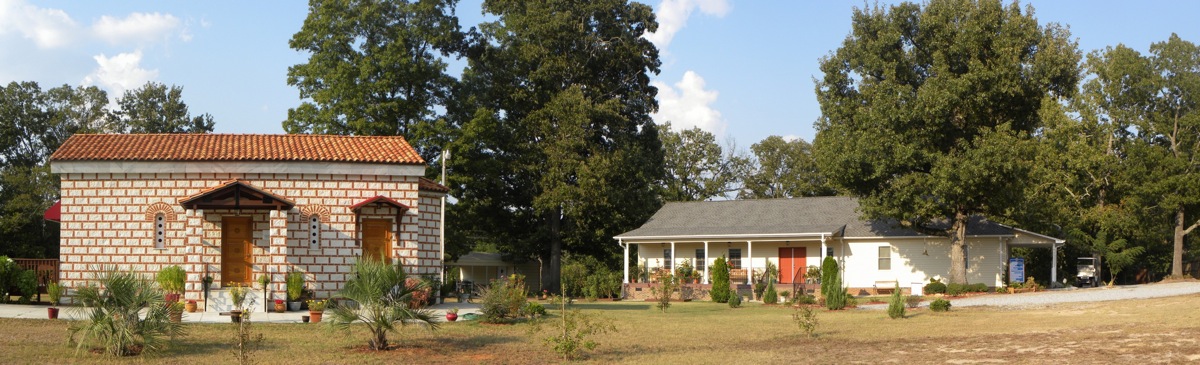
Pam and I visited her parents in the upstate Sunday night, and on the way back home yesterday made a detour through Abbeville. I had read of the opening of a new religious-type establishment and wanted to check it out for myself. The establishment, if you want to call it that, was actually a monastery and somehow had been built over the last couple of years in the backwoods of South Carolina, in as much a blue-collar agricultural district as you can find anywhere. You just drive down these country roads, with pastures and cows and soybean fields stretching out in the distance and then, there it is, the Paracletos ("Holy Spirit") Greek Orthodox Monastery, resting there in the middle of a corn field.


             So anyway, Pam and I went in to check the place out. When a middle-aged sister came out to greet us, we realized that even though it was called a “monastery” those who lived there were women not men. Three of them, in fact. Sister Miriam told us that the three of them had been brought over by the archbishop of the Greek Orthodox archdiocese of Atlanta, to begin the monastery a few years ago. To date, they’ve constructed a small and beautiful chapel, a dining hall for guests, their own residence, and a workshop where they make icons for their income needs. We spent a while talking with Sister Miriam and the Abbess, Sister Pauline (who didn’t speak English; Sister Miriam translated). A strange and unexpected conversation, to be sure. But one that was eye-opening for us:

Me: Sister Miriam, this place is so peaceful. So quite.

Sister Miriam: Yes, this is because we pray so much. Much prayer leads to much sanctity. What you’re feeling here is the holiness that comes to a place when we pray.

Pam: What’s your daily schedule like?

Sister Miriam: We arise every morning at 4:00AM for our first worship service of the day. We worship from the time we wake up until 7:30AM. Then we have breakfast. We work until 1:00PM—praying as we work!—then have lunch. After lunch we have our second worship service. Then we return to work, with a worship service later in the afternoon. We don’t eat supper and instead have a last worship service prior to retiring to our rooms for personal prayer and reading.

Me: What are your greatest challenges here?

Sister Miriam: There’s so much for us to pray for! We believe we’re called here to pray, and we want to see more sisters join our community so we can pray even more.

That’s a taste of our conversation. Needless to say, I was so deeply impressed by their commitment to pray! I don’t get much of their theology, or even of their lifestyle, but I was blown away by their prayer life.  Wherever there’s a sense of the presence of God, you can rest assured that prayer has preceded it. I came away from there with a renewed commitment to prayer, to seeking the face of God more than anything else. “Our place is sanctified through prayer,” Sister Miriam said. And she was right: you could feel it as soon as you walked around the grounds. I’m covetous (in a good way) of that same thing: in my heart, in my home, in my church.